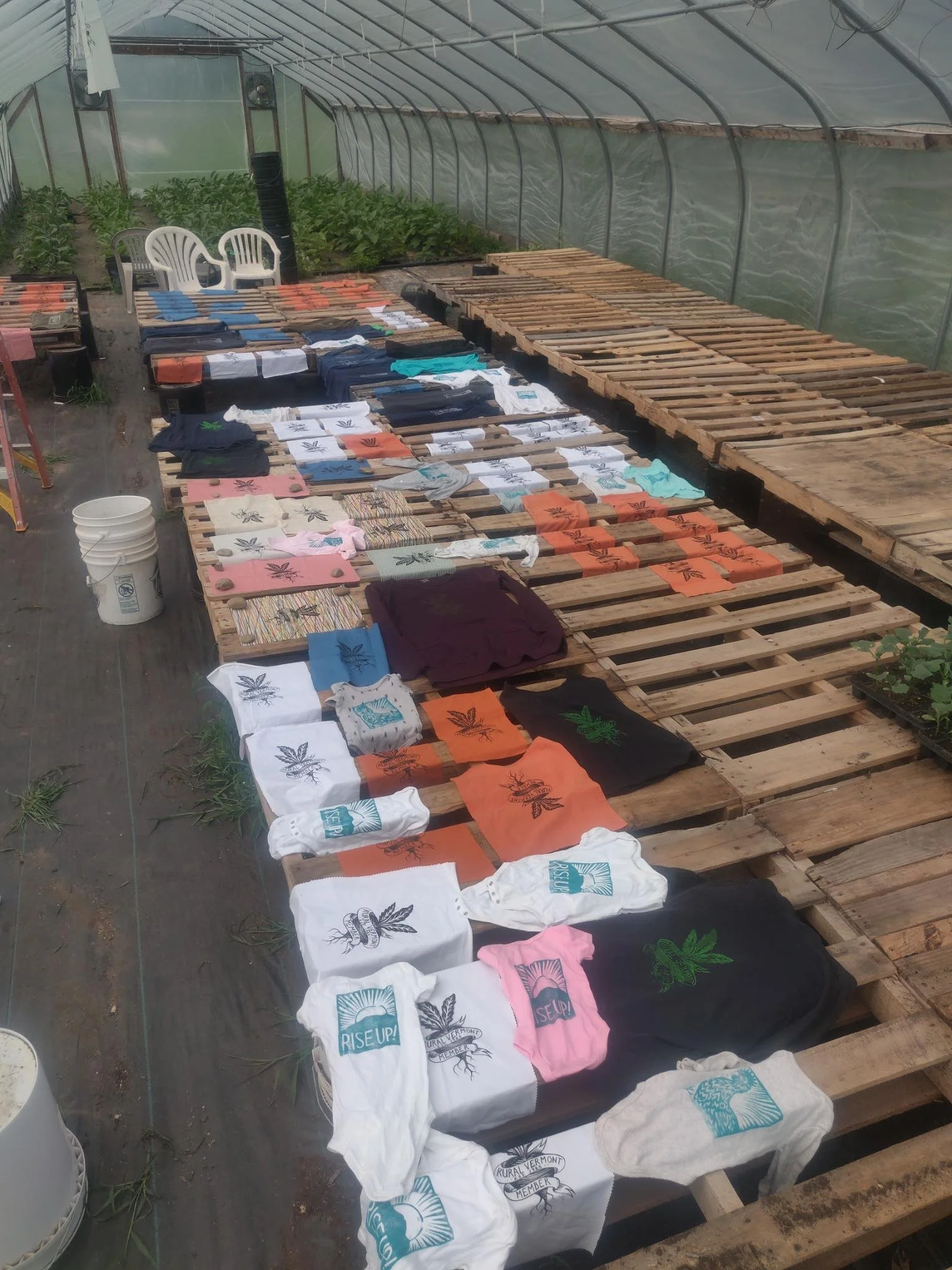
Farmer Organizing, Legislative Strategy, & Policy Writing at Rural Vermont
Rural Vermont has been organizing farmers since 1985 - dumping milk to protest price cuts that made dairy farming unsustainable, opposing the (disastrous) North American Free Trade Agreement, and winning state legal protections for practices like on-farm slaughter. Largely, the people doing the organizing here are also farmers, although the organization’s leadership and network includes homesteaders and passionate eaters as well. Rural Vermont’s vision is: “a just and equitable world rooted in reverence for the earth and dignity for all. This abundant and generous way of life celebrates our diversity and interdependence, in which communities of microorganisms, animals, plants, and humans tend one another and nurture generations to come.” Rural Vermont attracted me because its organizing connects the concrete and local (e.g. workshops on humane sheep slaughter) to the abstract and global (e.g. the ideals of agroecology and international peasant’s movement La Via Campesina).
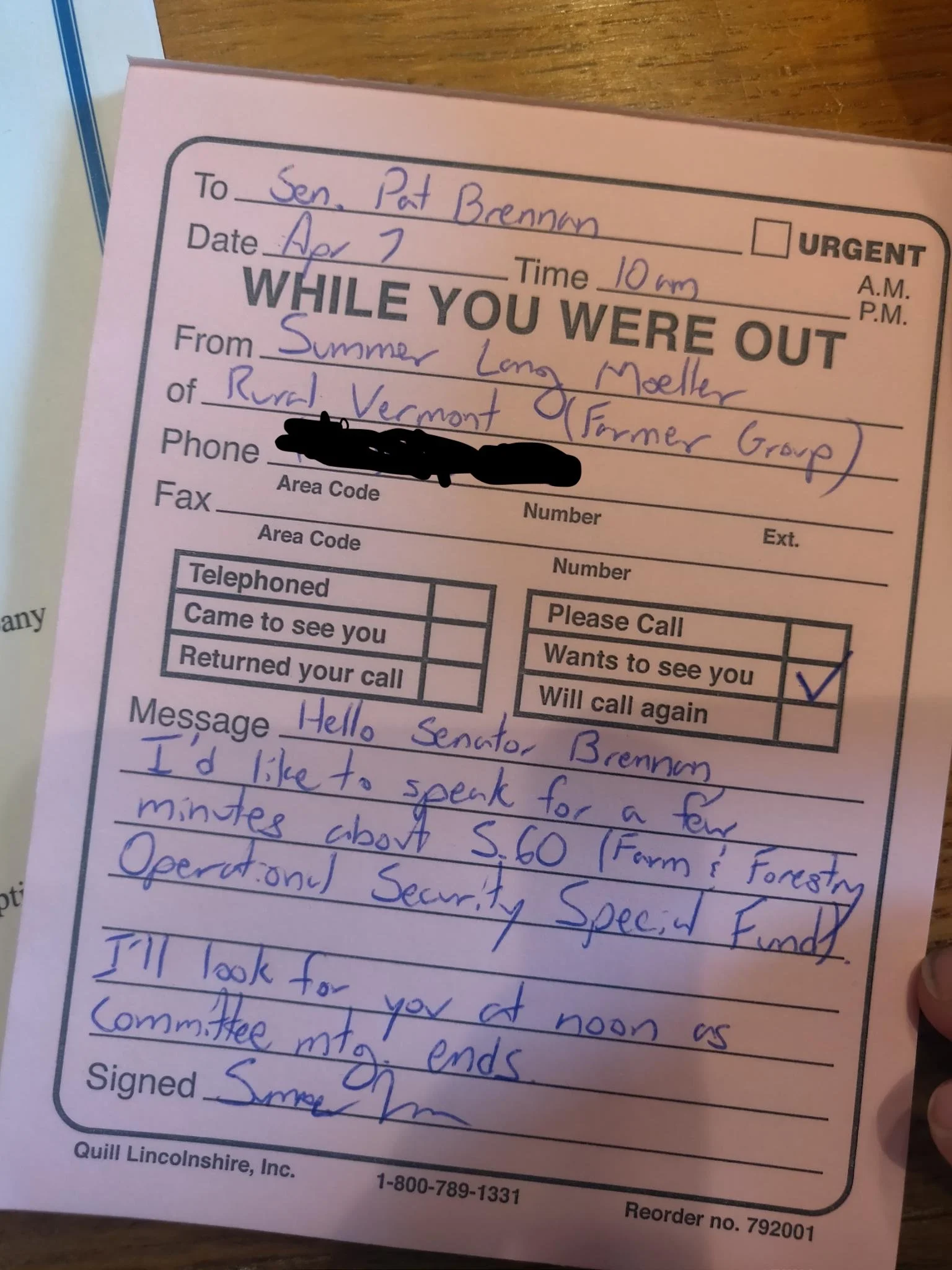
A memo I sent to a legislator asking for a meeting via the statehouse’s internal mail system.
I began my work each week (which started as an ‘internship’ but didn’t stay that way) by checking the schedules of the agricultural committees of the Vermont Legislature. Our policy team (myself and two other staff) would then divide up the hearings, doing our best to listen to everything related to the priorities already identified by our membership, and keeping an eye out for emergent issues (more on this challenge below). Every other week, after attending hearings and reading the relevant statute, we wrote a legislative update in plain language. Another team member turned this written update into a podcast for farmers to listen to while doing chores.
A key issue for us this session was the Municipal Exemption for Agriculture - a long-held rule that Vermont farms are regulated by the state and federal government, but largely exempt from town regulation (e.g. zoning can’t prohibit farming in certain areas). A state supreme court case had scrapped these critical protections a few months earlier – we set out to have the legislature reinstate them.
Based on what we were hearing early in the session, we had reason to believe that farms based in or near town centers and in certain regional planning zones would be most at risk of regulation from their towns. To find these farms, I built a mapping tool in QGIS (image below). Based on the mapping tool, and an interest form sent out earlier, we started cold calling farmers. Cold calls were initially a challenge for my socially-anxious brain, but turned out to be a highlight of the experience – I loved getting to connect with a new farmer, briefly explain the policy issue, and hear about their perspectives and experiences with town regulation. Through some of these conversations, we were able to support farmers in preparing to share their stories as testimony. Spending time with farmers in the statehouse, and seeing them influence legislators in person, was another highlight.
We worked on the Municipal Exemption issue in a coalition of other food and farming organizations that met most weeks. I learned so much from being part of that group of farmers and seasoned lobbyists, and witnessing the approaches evolve throughout the session. In particular, it was a pleasure to talk strategy multiple times a week with my supervisor Caroline, a brilliant attorney and successful sheep farmer.
A few months into the session, Rural Vermont’s Policy Director went on leave – I was asked to help fill in, so I left behind my ‘internship’ role and (temporarily) became a full member of the staff.
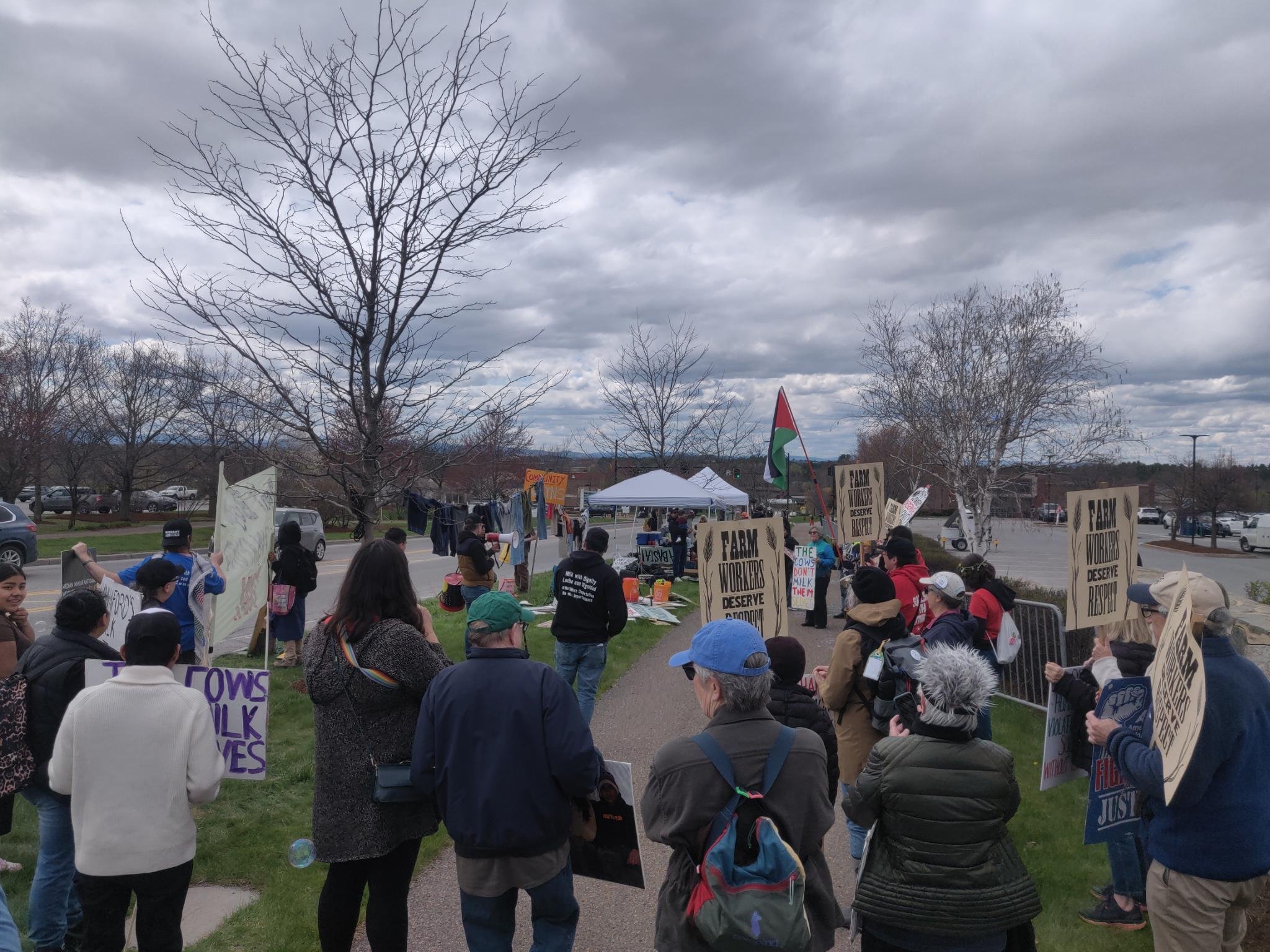
Picket of Hannaford Supermarket organized by Migrant Justice’s Milk with Dignity campaign. Rural Vermont staff and community showed up to support.
One of the hardest things for a member-driven political advocacy operation is that the legislature routinely creates issues that couldn’t have been anticipated, and moves much faster than most citizens, especially farmers, have time to engage with. As a scrappy little organization, we needed to stay focused on the issues our membership asked us to prioritize. At the same time, when legislative proposals arose mid-session that we believed would harm our members, we were sometimes the only people able to act quickly enough to influence the outcomes. This is exactly what happened with an innocuous-looking piece of seed legislation this session.
I was reviewing testimony, like any other week, when I came upon a hearing on seed law in a section of a bill on "miscellaneous agricultural subjects”. The testimony was being given by a seed trade association, and the messaging was as it had been the entire session: ‘this is inconsequential, it’s just about cleaning up some loose ends in our seed law.’ However, as I listened further, I started getting suspicious – I knew from my studies in Food Systems that there is often a deep divide between small farmers / seed keepers and the large-scale seed industry. Trade associations of ‘the industry’ are not all bad – there are no black and whites here. That said, over the years the industry has leveraged lobbyists and money to cause some profound societal and cultural harms. I did some digging to try to figure out who had proposed the language that was now before the legislators, who might benefit, and took time for a closer reading of the proposed changes. I realized that the bill intended to broaden the application of some seed regulations and fees, applying them not only to people selling seed, but also to people exchanging seed in almost any way. It would create some ambiguity, and might threaten barter and other forms of non-commercial exchange with regulations inappropriate for the scale of the exchange. Concerned, I got in contact with a local seed expert I knew from grad school, and explained what I was seeing - she reacted strongly, sharing my concerns. We then connected with a policy expert at NOFA-VT. Together, we rapidly reached out through both of our organizations’ networks to connect with a series of the state’s key seed experts in just a few days - from seed policy experts, to indigenous and euroamerican leaders in seed saving community work. With their input, we drafted a series of proposals, and an advocacy strategy, culminating in testimony by the NOFA-VT policy expert and the seed expert I originally spoke to. After multiple trips to the statehouse, our advocacy was successful - the legislature scrapped the problematic seed section, and our organizing created a new interest in co-authoring more desirable updates to our seed law in the coming year.
I’ve learned so much through my experience with Rural Vermont. I learned that I love the challenge of 1:1 organizing conversations with strangers, and the process of empowering farmers to change the systems around them. I learned that I find glee in reading statute closely, and motivation in writing about it in straightforward ways. I learned I find pride and fulfillment in sharing my skills with technology (skills so often abused in our society) in small, strategic ways with values-aligned organizations. Most importantly, met so many people I admire, folks who are grounded in soil, are burning to change big systems, willing to hold one another accountable, move with warmth and care, and retain the boldness to move quickly in alignment with their values when a situation demands it.
In the summer of 2026 I’ll be continuing to work with Rural Vermont as a consultant to help them move through the next chapters of their organizational development.